Where Does Your Waste Actually Go?
When the truck pulls your dumpster onto its flatbed and drives away, most people assume everything in it heads straight to a landfill. In reality, a significant percentage of dumpster contents (sometimes more than half) is diverted for recycling and material recovery. The waste management industry has invested billions of dollars in sorting technology and processing infrastructure over the past two decades, and the result is a sophisticated system that recovers valuable materials from what most people consider trash.
Understanding how this system works can change the way you think about what you put in your dumpster and how you load it. It can also help you make decisions (like separating materials or choosing a recycling-focused hauler) that reduce environmental impact and sometimes lower your disposal costs.
The Journey Begins: Transfer Stations
Most dumpster loads do not go directly to a landfill or recycling facility. They first go to a transfer station, a large industrial facility where loads from multiple trucks are consolidated, inspected, and sorted for their next destination.
At the transfer station, loads are dumped onto a tipping floor where workers and equipment inspect the contents. Loads that are clearly recyclable (clean concrete, scrap metal, clean wood) are routed to appropriate recycling facilities. Loads that are clearly trash go to the landfill. Mixed loads go through additional sorting, either at the transfer station or at a downstream material recovery facility.
Transfer stations exist because it is more efficient to consolidate loads before transporting them to their final destination. A transfer station might receive 50 small dumpster loads in a day, consolidate them into five large transfer trailers, and send those trailers to a landfill, recycling plant, or material recovery facility that may be 50 to 100 miles away.
Material Recovery Facilities
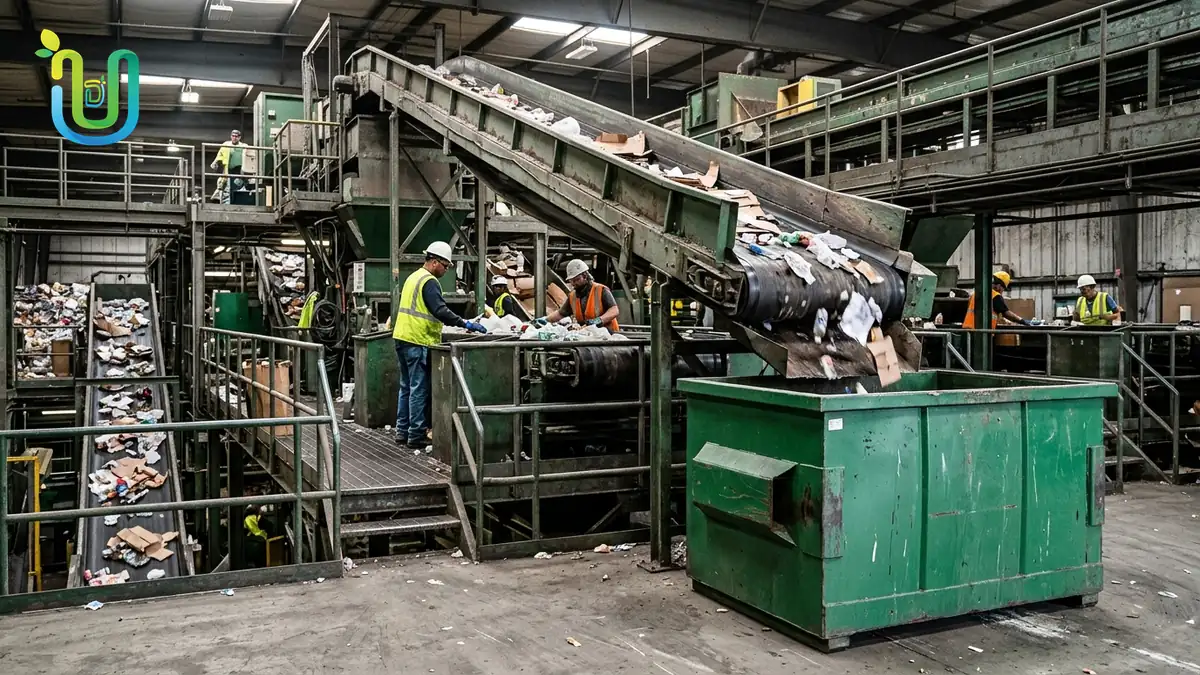
Material recovery facilities, commonly called MRFs (pronounced "murfs"), are the workhorses of the recycling industry. These facilities use a combination of manual labor and automated equipment to sort mixed waste into distinct material streams.
A modern MRF processes waste through a series of sorting stages:
Pre-sort. Workers on an elevated platform manually remove large items, hazardous materials, and contaminants from the waste stream as it moves along a conveyor belt. Plastic bags, which jam automated equipment, are pulled out at this stage.
Screens and trommels. Rotating drums with holes of varying sizes separate materials by size. Small items fall through first. Large items pass over the screen to the next stage. This separates things like broken glass from cardboard and large plastics.
Magnets. Powerful magnets positioned above the conveyor belt pull ferrous metals (steel and iron) out of the waste stream. Steel cans, nails, hinges, and other iron-containing items are captured and routed to a metals bin.
Eddy current separators. These devices use a rapidly alternating magnetic field to repel non-ferrous metals like aluminum and copper, sending them flying off the conveyor into a separate collection area. This is how aluminum cans and copper wire are recovered from mixed waste.
Optical sorters. Near-infrared sensors identify different types of plastic by their chemical composition and use jets of compressed air to sort them into separate streams. This technology can distinguish between PET (water bottles), HDPE (milk jugs), and other plastic types at high speed.
Manual quality control. After automated sorting, workers perform a final quality check, removing contaminants and misidentified items from each material stream.
What Gets Recycled from Dumpster Loads
The recycling potential of a dumpster load depends heavily on what is in it. Here are the most commonly recovered materials:
Metals. Steel, aluminum, and copper have high recycling value and are recovered at very high rates. Scrap metal from construction and demolition projects is one of the most reliably recycled materials in the waste stream.
Concrete and masonry. Clean concrete is crushed into recycled aggregate for use in road construction, fill material, and new concrete production. The recycling rate for concrete is extremely high in markets where crushing facilities exist.
Wood. Clean, unpainted wood can be chipped into mulch, processed for biomass energy, or recycled into engineered wood products like particleboard. Treated or painted wood typically goes to the landfill.
Cardboard and paper. Cardboard from packaging is one of the most commonly recycled materials. It is baled and sold to paper mills for reprocessing into new cardboard and paper products.
Asphalt shingles. Old shingles can be ground and blended into hot-mix asphalt for road paving. Not all markets have shingle recycling capabilities, but where it exists, it diverts a heavy waste stream from landfills.
What Cannot Be Recycled
Some materials consistently end up in landfills regardless of sorting efforts. Heavily contaminated materials (drywall with mold, insulation with moisture damage, mixed debris soaked in paint or chemicals) cannot be recovered. Multi-material composites that cannot be separated economically go to landfill. Certain plastics, especially films and flexible packaging, have limited recycling markets.
How You Can Help the Process
The single most impactful thing you can do is keep clean recyclable materials separate from contaminated waste. A dumpster full of clean concrete is easy to recycle. A dumpster where concrete is mixed with drywall, insulation, paint cans, and household trash is much harder and more expensive to process.
If your project generates large quantities of a single material (concrete, metal, wood, or cardboard), consider renting a separate container specifically for that material. The disposal cost for a clean, single-material load is often lower than for mixed waste, and the environmental benefit is significant.
At Ultimate Dumpsters, we work with disposal partners who prioritize material recovery. We can help you determine whether separating materials into multiple containers makes sense for your project, both environmentally and financially.