Know Before You Load
Every dumpster rental comes with a list of items you cannot throw in. These restrictions are not arbitrary. They are driven by federal environmental regulations, state hazardous waste laws, and the operational safety requirements of landfills and recycling facilities. Violating these rules can result in fines from your hauler, rejected loads at the disposal facility, and in some cases, legal penalties from environmental agencies.
The good news is that the list of prohibited items is consistent across most haulers and most regions. Once you know what cannot go in, you can plan ahead and arrange proper disposal for those items before your dumpster even arrives. Here are the ten most common items that are banned from standard roll-off dumpsters.
1. Flammable Liquids
Gasoline, kerosene, diesel fuel, lighter fluid, and other flammable liquids are strictly prohibited. A single container of flammable liquid can create an explosion risk during compaction or transport. Even empty containers that held flammable liquids can release dangerous vapors inside an enclosed dumpster.
Where to take them: Your local household hazardous waste facility will accept flammable liquids at no charge. Many fire departments also coordinate collection events throughout the year.
2. Wet Paint and Lacquer
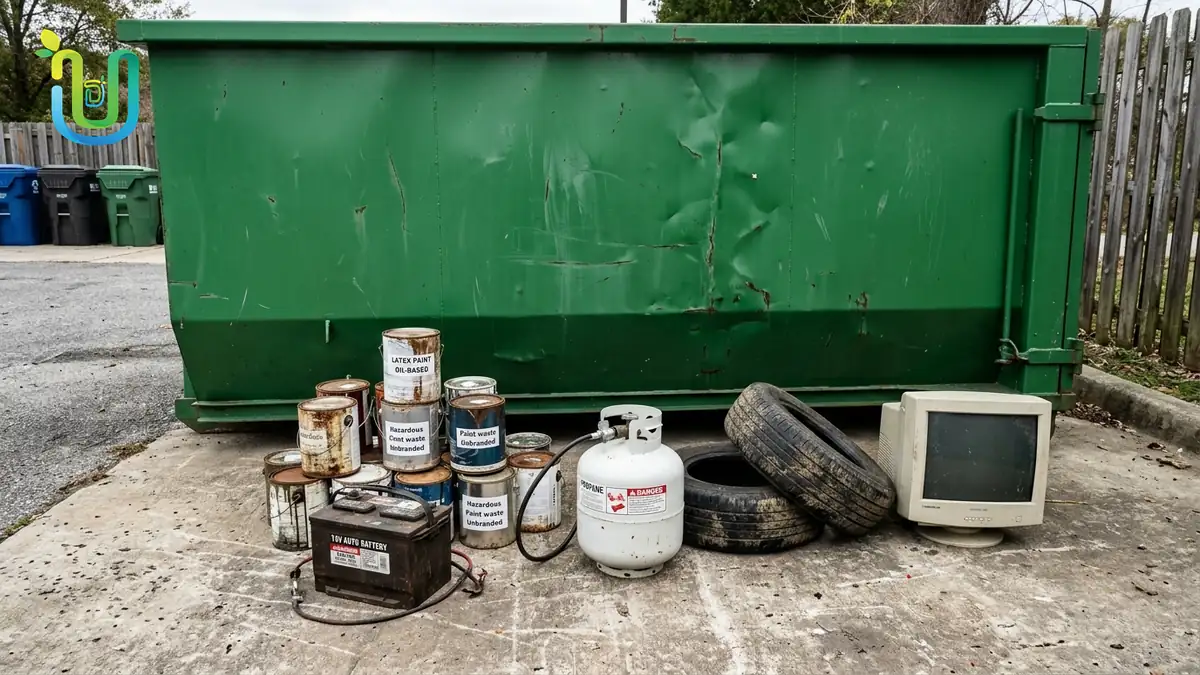
Oil-based paints, lacquers, and liquid stains are classified as hazardous waste because of their chemical solvents. Even latex paint in liquid form is prohibited by most haulers because it can leak and contaminate other materials in the dumpster, making the entire load unrecyclable.
Where to take them: Household hazardous waste collection centers accept all paint types. For latex paint, you can also dry it out completely (mix with cat litter, leave the lid off until solid) and dispose of it in regular trash in most municipalities.
3. Automotive Fluids
Motor oil, transmission fluid, brake fluid, antifreeze, and power steering fluid are all prohibited. These fluids contain toxic chemicals that contaminate soil and groundwater, and even a small spill can affect a large area.
Where to take them: Auto parts stores like AutoZone and O'Reilly accept used motor oil and automotive fluids for free. Many quick-lube shops will also take them.
4. Pesticides and Herbicides
Chemical pesticides, herbicides, fungicides, and insecticides, including common products like weed killers and ant sprays, are classified as hazardous waste. These chemicals are designed to kill living organisms, and they remain toxic in landfill environments.
Where to take them: Household hazardous waste programs are the proper disposal channel. Never pour pesticides down a drain or into a storm sewer.
5. Propane Tanks and Compressed Gas Cylinders
Any container holding compressed or liquefied gas (propane tanks, oxygen cylinders, acetylene tanks, helium tanks, and aerosol cans that are not fully empty) can explode under pressure. Compaction equipment at transfer stations and landfills applies enormous force, and a pressurized container in the wrong place can cause serious injuries.
Where to take them: Propane exchange locations (available at most hardware stores and gas stations) accept old tanks. Scrap metal dealers accept empty tanks with the valves removed. Full or partially full tanks should go to a hazardous waste facility.
6. Batteries
Lead-acid car batteries contain sulfuric acid. Lithium-ion batteries can short-circuit and ignite under pressure. Even alkaline batteries contain chemicals that can leach into groundwater. All battery types are prohibited in dumpsters.
Where to take them: Auto parts stores accept car batteries for free and will often give you a core credit. Electronics retailers accept rechargeable batteries. Many grocery stores and libraries have collection bins for household batteries.
7. Refrigerators, AC Units, and Freon Appliances
Here is one that surprises people: freon appliances are not actually prohibited. The refrigerant gases must be professionally recovered before disposal (the Clean Air Act prohibits venting refrigerants into the atmosphere), but the appliance itself can go in the dumpster after that. Landfills charge a per-item fee for appliances that varies by area.
What to do: Contact a certified HVAC technician to evacuate the refrigerant, or ask us: we call the landfill, get the exact per-item rates for your area, and relay them back before you load. Utility companies and scrap dealers also accept de-gassed appliances.
8. Medical and Biohazardous Waste
Needles, syringes, blood-soaked materials, expired medications, and any material contaminated with bodily fluids are classified as biohazardous waste. These items pose direct health risks to haulers, landfill workers, and anyone who comes into contact with them.
Where to take them: Sharps containers are available at pharmacies and can be dropped off at designated collection sites. Many pharmacies participate in drug take-back programs for medications. Hospitals and medical offices use licensed medical waste haulers.
9. Asbestos
Found in older homes in insulation, floor tiles, ceiling tiles, pipe wrap, and roofing materials, asbestos is a known carcinogen regulated by the EPA. Disturbing asbestos without proper containment releases microscopic fibers that cause mesothelioma and other cancers.
Where to take it: Asbestos must be handled by a licensed abatement contractor. It is wetted, double-bagged in labeled polyethylene sheeting, and transported to a landfill specifically permitted to accept asbestos waste. This is not a DIY job.
10. Contaminated Soil
Soil that has been contaminated by petroleum products, industrial chemicals, heavy metals, or other hazardous substances cannot go in a standard dumpster. Contaminated soil requires testing to determine the type and level of contamination, followed by disposal at an approved facility.
Where to take it: Environmental remediation companies handle contaminated soil testing, transport, and disposal. Your state environmental agency can provide a list of approved facilities.
How to Handle Prohibited Items During Your Project
The best approach is to identify any prohibited items before your project starts and arrange alternative disposal in advance. Walk through your project area, set aside anything that cannot go in the dumpster, and schedule drop-offs or pickups for those items separately.
If you discover a prohibited item during your project, set it aside rather than tossing it in the dumpster. Most haulers inspect loads before and after pickup. If prohibited materials are found, you may face a contamination surcharge; the exact amount depends on the material and the disposal facility.
When in Doubt, Ask
At Ultimate Dumpsters, we include a prohibited items list with every rental confirmation. If you are unsure whether a specific item can go in your dumpster, call us before loading it. Our team handles these questions every day and can point you to the right disposal option quickly. It is always better to ask than to risk a rejected load or a contamination fee.