
The Daily Haul
ALL THE DEBRIS THAT'S FIT TO DUMP
Comparison Between Front-Load Dumpsters and Roll-Off Dumpsters: Which One Does Your Business Actually Need?
Search "commercial dumpster rental near me" and you get two very different containers pretending to be one answer. A front-load is the lidded box that lives behind your business and gets emptied on a weekly route. A roll-off is the open-top project box that shows up, fills once, and leaves. Here is the honest read on which one your business needs, so you set up the right service instead of the wrong one.
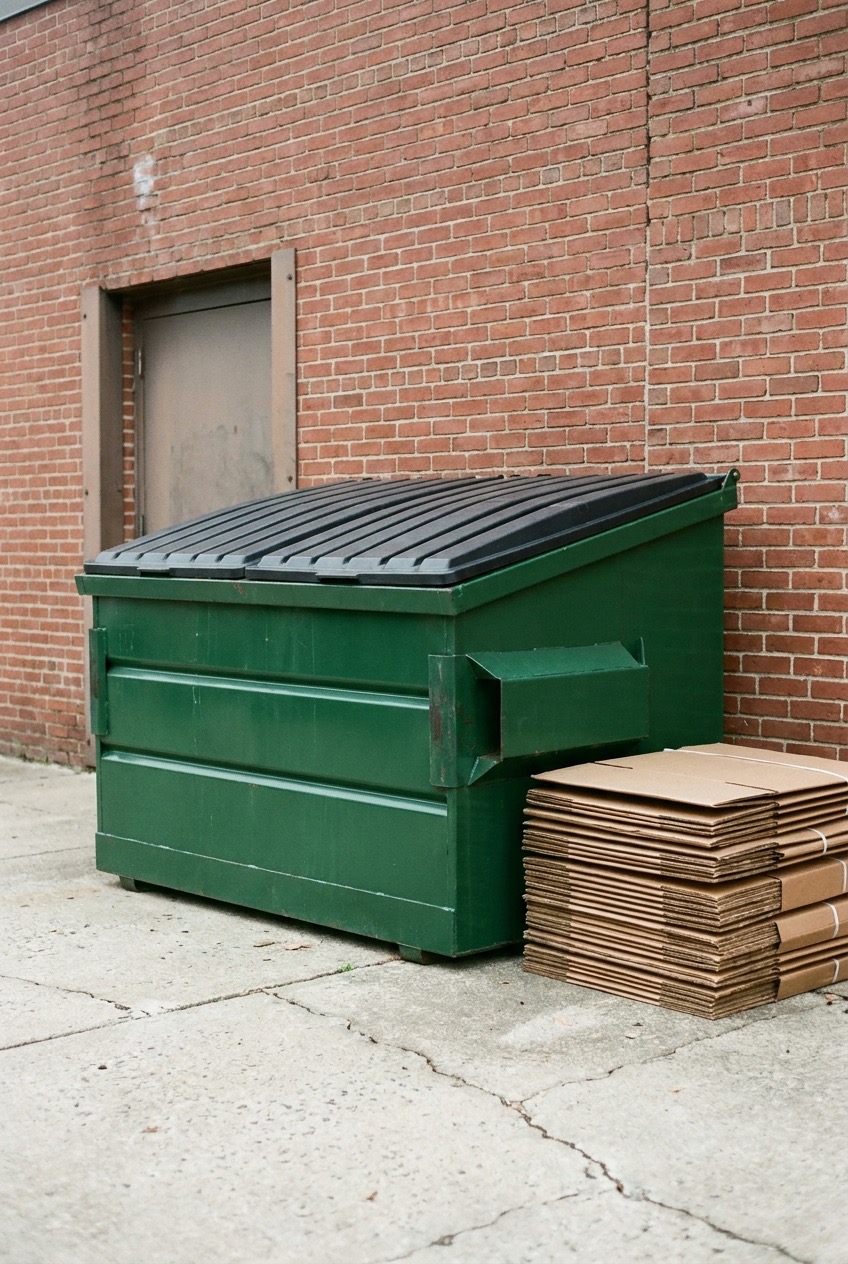
When a business searches for a commercial dumpster, it is usually asking one of two questions without knowing they are different. The first is: where does the everyday trash go, week after week? The second is: what do I do with the pile from this renovation or cleanout? Those are two separate containers. Recurring weekly business waste goes in a front-load. A one-time project goes in a roll-off. Plenty of businesses run both at the same time, one on the loading dock permanently and one in the lot for a month. Getting the two straight is the whole game, and most companies never explain it.
A front-load is the lidded container you have seen behind every restaurant, store, and office building. It is 2, 4, 6, or 8 cubic yards, it stays on-site full time, and a truck comes on a set route to lift it, empty it, and set it back down. Every front-load is 6 feet long and grows by width and height as it gets bigger. A 2-yard is 6 by 3 by 3 feet and holds 8-10 trash bags, right for a small office, salon, boutique, or cafe with under 10 employees on about one pickup a week. A 4-yard is 6 by 5 by 4 feet and holds 16-20 bags on 1-2 pickups a week, and it is the most popular size we place, the fit for mid-size restaurants, retail stores, clinics, and small apartment buildings. A 6-yard is 6 by 6 by 5 feet, 24-30 bags, 2-3 pickups a week, for high-volume daily waste like large restaurants, grocery stores, hotels, and office buildings. An 8-yard is 6 by 6 by 7 feet, 32-40 bags, 3-5 pickups a week, the largest front-load made, for shopping centers and warehouses.
A roll-off is a different animal for a different job. It is the open-top box, 10 to 40 cubic yards, delivered to your site for a project and hauled away when it is full. You use it for a renovation, a buildout, a big cleanout, or construction and demolition debris, the stuff that comes all at once and then stops. It does not stay on a route. It comes, it fills, it goes. If your business is remodeling, gutting a space, or clearing out years of accumulation, that is a roll-off, and the size pages publish real per-ZIP pricing for them online. If your business just makes trash every week the way every business does, that is a front-load, and it never should have been a roll-off.
The pickup schedule on a front-load is not a contract you are locked into, it is a route setting we adjust with one phone call. Very low volume can run bi-weekly. A busy kitchen can run daily. Most businesses land somewhere between one and three pickups a week and change it as they grow or slow, seasonally or for good. If your box is overflowing by Thursday, we add a pickup. If it is half-empty every week, we pull one and you pay less. That flexibility is the point of a front-load: it flexes to your actual waste instead of forcing you to guess a year ahead.
Here is the part most companies bury: there is no flat national price for a front-load. Commercial pricing is set market by market, because it depends on your location, the container size, how often it gets emptied, and what kind of waste goes in. That is not a dodge, it is the honest answer, and it is why a real quote comes to your address, not off a chart. Call the commercial desk at (866) 858-3867, tell us your business, your size, and roughly how much trash you make, and you get one all-inclusive number, usually within the hour. Tell us the job, we tell you the box, and we set up the right service the first time.
Capacity, bag equivalents and typical pickup frequency for the four front-load container sizes, from Ultimate Dumpsters live commercial size-page specs. Bar length is a visual scale of volume, not a percentage. Every front-load is 6 feet long and grows by width and height. The 4-yard is the most popular size. Pickup frequency is a route setting adjustable with one call, from bi-weekly for very low volume up to daily for busy kitchens.
“Every business asks for a commercial dumpster like it is one thing. It is two. If you make trash every week, that is a front-load on a route. If you are gutting a space, that is a roll-off for the project. Tell me which one you are living, and I will set up the right service instead of the wrong one.”
from the commercial desk
The question I ask first is simple: is this your everyday trash, or is it one job? Everyday trash is a front-load, and it flexes with a phone call. One job is a roll-off, and it leaves when it is done. People get sold the wrong one all the time because nobody stopped to ask.
The 4-yard is the one we place most, it fits the mid-size restaurant and the retail store almost every time. And the schedule is not a trap. Overflowing by Thursday, we add a pickup. Half-empty every week, we pull one and you pay less. That is the whole point of a route.
TODAY'S NUMBERS · FROM THE ORDER LEDGER
What is a commercial dumpster, and do I need a front-load or a roll-off?
A commercial dumpster is one of two very different containers. A front-load is the lidded 2 to 8 cubic yard box that lives behind your business full time and gets emptied on a recurring weekly route, and it is what you want for the everyday trash a business makes week after week. A roll-off is the open-top 10 to 40 cubic yard box delivered for a project and hauled away when it is full, and it is what you want for a renovation, a cleanout, or construction and demolition debris. So the rule is simple: recurring weekly business waste means a front-load, and a one-time project means a roll-off. Many businesses run both, one on the dock permanently and one in the lot for a month. Front-load sizes range from a 2-yard for a small office up to an 8-yard for a shopping center, with the 4-yard the most popular. Pickup frequency runs from bi-weekly up to daily and adjusts with one call. Front-load pricing is quoted to your address because it depends on location, size, frequency, and waste type.
See all commercial front-load sizes and get a quote →FRONT-LOAD SIZES
Placed by the desks of Ultimate Dumpsters. Every listing is real.
EVERYDAY BUSINESS WASTE. Restaurant, store, office, or clinic making trash every week? That is a front-load on a route. The 4-yard fits most mid-size businesses. Tell us your volume and get one all-inclusive quote to your address.
See the 4 yard front-load →ONE-TIME PROJECT. Renovation, buildout, or big cleanout? That is a roll-off, not a front-load. Open-top, delivered then hauled when full, with real per-ZIP pricing online. Do not put a project in a weekly-route box.
See roll-off rental →NOT SURE WHICH. Everyday trash or one job? Front-load or roll-off? Call the commercial desk at (866) 858-3867 and we size it right the first time, one quote, usually within the hour.
Talk to the commercial desk →AN ADVERTISEMENT FROM THE PUBLISHER
The Box Arrives Before The Coffee Is Done
(866) 858-3867or skip the call entirely
Order online in about 2 minutesExact local pricing, tonnage and rental days included, e-sign and pay from your phone.
Container sizes, dimensions, bag equivalents and typical pickup frequencies are drawn from Ultimate Dumpsters live commercial size-page specs, current for 2026. Front-load pricing is deliberately not published as a flat figure because it is set per market, depending on location, container size, pickup frequency, and waste type, and is quoted to the service address, one all-inclusive number usually within the hour by phone at (866) 858-3867. Roll-off sizes carry published per-ZIP pricing on the size pages. Bag figures are standard capacity conversions, not proprietary counts. Published weekday mornings by Ultimate Dumpsters. Vol. I · No. 20.