Call Now:(866) 858-3867Live agents standing by
ALL THE DEBRIS THAT'S FIT TO DUMP
Two people rent the exact same box for the exact same pile, and one fits the whole job while the other calls for a second dumpster. The difference is not the box, it is how you pack it. Here is how the pros load a roll-off so every cubic foot counts, plus the one line you can never load past.
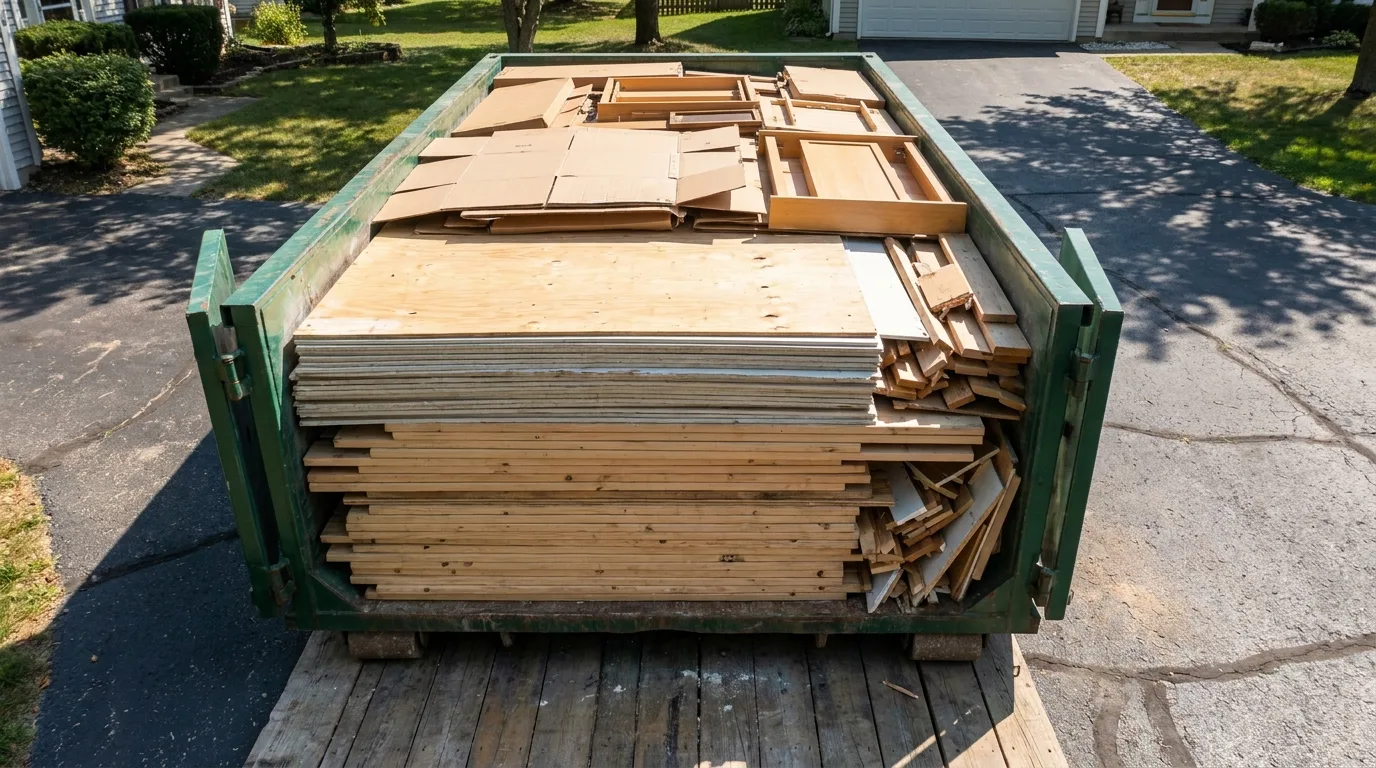
Most people load a dumpster the way they load a car trunk in a hurry: big stuff in first, everything else thrown on top, air pockets everywhere. Then they are shocked when a 20-yard is full and half the pile is still on the lawn. The box did not shrink. It filled with air. A roll-off is rented by volume, so every empty gap between a couch cushion and a busted door is space you paid for and did not use. Pack it like the pros and the same container swallows noticeably more of your job, often enough to turn what looked like a two-haul project into one. Here is exactly how to do it.
Rule one: heavy, flat things go in first, laid down across the floor. Plywood, drywall sheets, old doors, countertops, plank flooring, busted furniture panels. Lay them flat and build a level base layer, do not stand them up against the wall. A flat base does two things: it uses the floor of the box completely, and it gives you a hard, even surface to stack on top of instead of a lumpy pile that wastes the space above it. Think of it like packing a moving truck, the flat, heavy, sturdy stuff is your foundation, everything else builds up from there.
Rule two: break down anything with air in it. This is where most of the wasted space hides. A whole dresser is mostly empty drawers, pull the drawers, and it packs flat. A cabinet, a bookshelf, a table with legs, a mattress and box spring, cardboard boxes, they are all air with a frame around them. Knock furniture apart, snap the legs off, flatten every box, cut down long boards so they lie flat instead of bridging across the container at an angle. Ten minutes with a hammer or a utility knife can free up a quarter of the box. A pile of intact furniture is a pile of air; a pile of broken-down furniture is flat, dense, and stackable.
Rule three: fill the gaps as you go, do not save them for the end. Every time you set a big item, you create small voids around it, and those voids are where your loose junk belongs. Toss bags of debris, scrap wood, small boxes, and odds and ends down into the pockets between the big pieces instead of piling them on top. Load in layers, flat and heavy on the bottom, medium in the middle, light and loose worked into the gaps, and keep it roughly level as you build up rather than making a mountain in the middle. A box packed in level layers holds far more than the same box with a peak in the center and empty corners.
Now the one rule you cannot break, and it is not about fitting more, it is about the load being legal to haul: do not load above the top rail. The debris has to sit level with the top edge of the container, never heaped over it. This is not a preference, it is a road-safety law. A box mounded over the top is a load that can shed debris on the highway, and if a piece of wood works loose at speed and hits a windshield, that is a serious accident and it is on us, the hauler. So when a container comes in heaped over the rim, we may have to ask you to pull material off the top before we can legally take it, which stalls your job and helps nobody. Pack it smart and level and you will fit more UNDER that line than you would have by piling it over. Level to the rail is the target, and a well-packed level box beats an overfilled sloppy one every time.
The other half of not paying twice is the weight limit, because a dumpster has two ceilings, space and weight, and you hit whichever comes first. Every rental includes a set tonnage allowance, and going over it costs roughly 150 to 185 dollars per extra ton on top of your price. That matters most with dense material: concrete, dirt, brick, tile, and shingles are heavy enough that a big box full of them blows past the legal road weight before it is anywhere near full. So the move for heavy debris is the opposite of bulky debris, use a smaller box built for weight, not a bigger one, and keep the heavy stuff to its own load. Mixing a little heavy in with a bulky household load is fine; filling a 30-yard with concrete is how you get a surprise overage bill. When in doubt, tell us the heaviest thing going in and we will size it so the weight and the space run out at the same time.
The costliest mistake of all is the one people make to save fifty bucks: renting one size too small. A second haul is not half price, it is a whole second delivery and a whole second pickup, which is far more than the jump to the next size up would have cost. So the honest play is to pack smart AND size honestly: load in flat, dense, gap-filled layers to get every cubic foot out of the box, keep it level to the rail, keep an eye on weight if the material is heavy, and if the job is genuinely on the line between two sizes, go up one. Do that and the whole thing clears in a single haul, which is the cheapest dumpster rental there is. When you are ready, you can price your job and book the right size online in a couple of minutes, or use the free dumpster size calculator if you want a second opinion on which box clears your pile in one trip.
Same box, same pile, very different results. A roll-off is rented by volume, so air pockets are wasted money. Packing in flat, dense, level layers can be the difference between one haul and two. Bar length is an illustration of usable space, not a precise measurement.
| Step | What to do | Why it works |
|---|---|---|
| 1. Base layer | Lay heavy, flat items across the floor (plywood, drywall, doors, panels) | Uses the whole floor and gives a level surface to stack on |
| 2. Break it down | Pull drawers, knock furniture apart, flatten boxes, cut long boards | Removes the air; intact furniture is mostly empty space |
| 3. Fill the gaps | Work loose bags and small debris into the voids around big items | Turns wasted pockets into used space |
| 4. Build in level layers | Keep it roughly level as you go, no mountain in the middle | A peak leaves the corners empty and the box only looks full |
| 5. Stop at the rail | Keep everything level with the top edge, never heaped over | Over the rim is not legal or safe to haul |
| 6. Mind the weight | Keep heavy debris (concrete, dirt, shingles) to a smaller box | Dense material hits the weight cap before the box is full |
A roll-off is rented by volume and capped by weight, so the goal is to fill the space densely while staying under both the top rail and the tonnage allowance. Pack this way and most jobs clear in a single haul.
“I can look at a loaded box and tell you in two seconds whether somebody knew what they were doing. The pros lay it flat and dense, heavy stuff on the floor, everything broken down, and it comes in level to the rail and heavy for its size. The folks who struggle throw the couch in whole, pile everything on top of it, and call me saying the box is full with half the garage still sitting there. Same container, same junk. Ten minutes with a hammer breaking things down flat is the difference between one haul and paying for two. And whatever you do, do not heap it over the top, I cannot legally put that on the road, and I do not want somebody's windshield paying for it.”
From the loading dock
The single biggest thing people get wrong is loading big items whole. A dresser, a cabinet, a bookshelf, a TV stand, those are ninety percent air. Pull the drawers, knock the sides apart, lay it flat, and the same piece takes up a third of the room it did intact. I tell every customer, spend ten minutes with a hammer before you start throwing things in. That ten minutes is worth a whole size of dumpster.
Think of it like packing a moving truck. Flat, heavy, sturdy stuff on the floor first, laid down, not standing up, so you get a solid level base. Then medium items, then work all your loose bags and small debris down into the gaps around the big pieces. Build it up in level layers. The mistake is making a pyramid in the middle, that leaves all four corners empty and the box looks full when it is really half air.
On a job site the two things that cost money are a second haul and a weight overage, and both are avoidable. Pack tight and level so you never need the second box. And know your material, if it is heavy, concrete, dirt, brick, shingles, keep it in a smaller box on its own, because a big container full of that hits the road-weight limit long before it looks full. Bulky goes big, heavy goes small. Get those two right and the job clears clean in one trip.
Fitting more in a dumpster comes down to packing it in flat, dense, level layers instead of piling items in whole, because a roll-off is rented by volume and every air pocket is space you paid for but did not use. Start with the heavy, flat items on the bottom: plywood, drywall, doors, countertops, and furniture panels laid flat across the floor to build a solid, even base, rather than stood up against the walls. Next, break down anything with air in it, which is where most wasted space hides: pull the drawers out of dressers, knock cabinets and shelves apart, flatten every cardboard box, and cut long boards down so they lie flat instead of bridging across the container at an angle. Then fill the gaps as you go by working loose bags, scrap, and small items down into the voids around the big pieces instead of piling everything on top, and keep the load roughly level as you build up rather than making a mountain in the middle that leaves the corners empty. There is one rule you cannot break: never load above the top rail. Debris must sit level with the top edge of the container, because a load heaped over the rim is not legal or safe to haul down the road, and the hauler may have to ask you to remove material off the top before pickup. A dumpster also has a weight limit as well as a volume limit, so with heavy material like concrete, dirt, brick, or shingles, use a smaller box built for weight rather than a large one, since dense debris hits the legal road weight before the box is full, and going over the included tonnage typically costs about 150 to 185 dollars per extra ton. Finally, the costliest mistake is renting one size too small to save a little money, because a second haul is a full additional delivery and pickup, far more expensive than sizing up once. Pack smart and level, keep the heavy stuff to a right-sized box, and when a job is genuinely between two sizes, go up one, and the whole thing clears in a single haul.
Size your job with the free calculator →Placed by the desks of Ultimate Dumpsters. Every listing is real.
BOOK THE RIGHT BOX. Pack smart, size honestly, clear it in one haul. Price your job and book the right roll-off online in a couple of minutes, one flat price, all in.
Order online →NOT SURE WHICH SIZE. On the line between two sizes? Use the free dumpster size calculator so you go up one when it counts and skip the second haul.
Size calculator →KNOW THE WEIGHT. Heavy debris hits the weight cap before the box is full. Estimate your tonnage first so an overage never surprises you.
Weight calculator →TALK TO A REAL PERSON. Tell us what is actually going in the box and we size it so the space and the weight run out at the same time. No upsell, no games.
Get a quote →AN ADVERTISEMENT FROM THE PUBLISHER
The Box Arrives Before The Coffee Is Done
(866) 858-3867or skip the call entirely
Order online in about 2 minutesExact local pricing, tonnage and rental days included, e-sign and pay from your phone.
This edition is a practical how-to on loading a roll-off dumpster efficiently, aimed at helping renters fit more of their job in one box and avoid the cost of a second haul or a weight overage. The techniques are standard, real-world loading practice: build a flat, heavy base layer; break down furniture and boxes to remove air; fill gaps around large items with loose debris; load in level layers; and keep the load level with the top rail. The top-rail rule is accurate and important: debris must sit level with the container's top edge and cannot be heaped over it, because an overfilled load can shed debris in transit and is not legal or safe to transport, so a hauler may decline to take it until material is removed. The weight guidance reflects how roll-off rentals actually work: every rental includes a set tonnage allowance, dense materials like concrete, dirt, brick, tile, and shingles reach the legal road-weight limit before the container is volumetrically full, and overage on the included tonnage runs about 150 to 185 dollars per additional ton (real national aggregate figures). The point that a second haul costs a full additional delivery and pickup, more than sizing up once, is a true reflection of how rental pricing works. Ultimate Dumpsters' model is one all-in price that includes delivery, pickup, disposal, rental period, and a set tonnage allowance. No invented statistics; the illustrative bar chart is a visual of usable space, not a precise measurement. Team quotes are verbatim from Ultimate Dumpsters staff. Article copy drafted with an external model and fact-checked against real roll-off loading practice and Ultimate Dumpsters' real pricing and weight policies. Published weekday mornings by Ultimate Dumpsters. Vol. I · No. 50.