
The Daily Haul
ALL THE DEBRIS THAT'S FIT TO DUMP
The Honest Playbook for a Monthly, Long-Term Dumpster Rental
Not every job fits inside seven days. A gut renovation runs six weeks. A long build fills a box every couple of weeks for months. A stage-by-stage property cleanout drags into fall. When the standard week does not match the work, you have two clean options: keep one box longer at a per-day rate, or run a swap cycle so a full box leaves and an empty one lands. Here is how a monthly, long-term dumpster rental actually works.
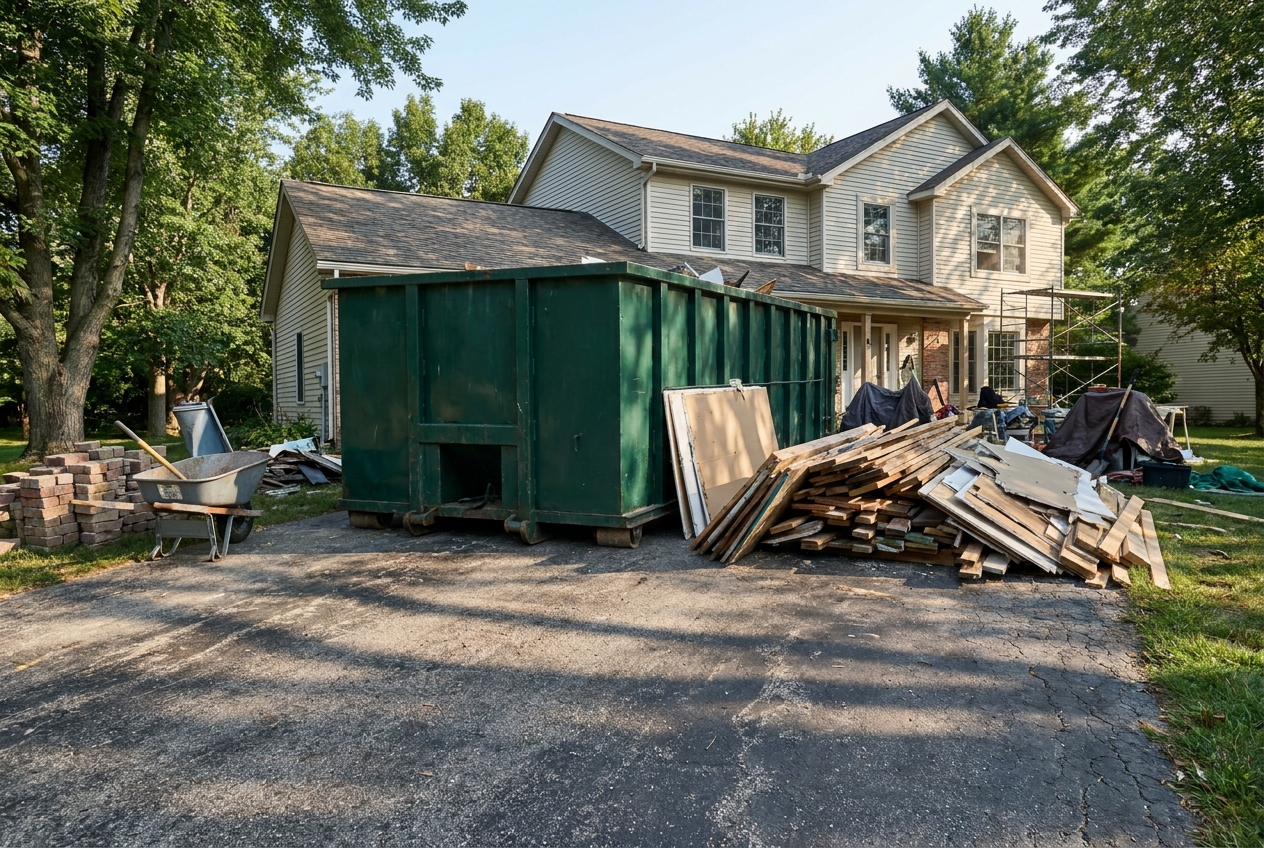
The standard roll-off rental is built around one number and one week. You get an all-in price that already includes delivery, pickup, disposal, seven rental days and a set tonnage allowance, and for most jobs that is exactly right. But a real monthly, long-term dumpster rental is a different animal. An ongoing renovation, a long ground-up build, a property cleanout you are doing in stages, or a business that quietly fills a box every few weeks does not wrap up on day seven, and pretending it will is how people end up paying for a second full delivery they never needed. The honest version is simpler than it sounds: you either keep the same box longer, or you swap it on a cycle, and which one fits comes down to how fast your debris piles up.
Keeping the box longer is the first path, and it is the right one when the work is continuous but the box does not overflow. Extended rental works by adding rental days at a per-day rate on top of the base rental, so a monthly setup is really a base dumpster rental plus the extra days you need to reach a month. Nothing exotic, no new delivery, the same box stays on your driveway or lot and the meter simply runs at a known daily rate you agree to up front. For a slow-burn job, a long interior remodel where the debris trickles rather than floods, that is usually the cheapest way to cover four weeks or more, because you are paying for time, not for a second haul.
The second path is the swap cycle, and for a lot of long jobs it is the smarter one. Instead of one box sitting full and useless for two weeks while you wait, we pick up the full box and drop an empty one each time it fills. You keep working, the debris keeps leaving, and you never lose days to a box you cannot load. A ground-up build, a heavy demolition phase, or a commercial account that generates steady volume is almost always better served by a swap cycle than by one box that maxes out and then just sits there taking up space. The rule of thumb: if you would fill a box faster than you would run out of month, swap it; if the month runs out first, extend the days.
Sizing matters more on a long job than a short one, because the box you pick sets the rhythm of the whole rental. Go too small on an ongoing build and you are swapping constantly and paying for each trip. A 30 yard dumpster is the honest workhorse for a long renovation or a staged cleanout: it holds enough that a swap cycle stays sane, and it is the size most people underestimate when they picture months of debris rather than a weekend. If you are not sure where your job lands, the full size lineup lets you compare before you commit, and you can price your exact ZIP so the number you see is real for your address, not a national guess. On price: the legit low end for a smaller box in cheaper metros runs about $395-495 for a 10 or 15 yard, while NY metros run higher, roughly $460-895 depending on size, and a monthly rate is that base plus your extended days or your swap trips, all quoted before anything lands.
One placement note that trips up long jobs specifically: where the box legally sits does not change just because you are keeping it for a month. On private property, a driveway or a lot, you are clear with no permit. On a New York City street, a roll-off needs a City permit, and a box that is going to sit on the curb for weeks is exactly the one you do not want caught without paperwork. When you order and tell us it is street placement, we flag that for you. Delivery is still same-day or next-day in most areas, so a long job does not mean a long wait to start. When you are ready, you can price your ZIP and order online, or if you are in the metro you can start from our New York coverage and we will set the box, the size, and the cycle to match how your job actually runs.
A monthly, long-term rental is not a separate product, it is a base rental plus the extended days you need, or a recurring swap when the box fills faster than the month runs out. The bar length is a visual scale of job length, not a percentage.
“The mistake on a long job is treating it like a big short job. People order one giant box and let it sit full for two weeks. The honest answer is a swap cycle: we pull the full one, drop an empty one, and you never lose a day to a box you cannot load. Match the rhythm to the work, not to your worst-case guess.”
From the long-haul desk
On anything past a couple of weeks I want to know how fast the box fills before I quote it. A slow interior remodel just needs extended days on the same box. A demolition phase or a steady build needs a swap cycle, because a box sitting full for two weeks is two weeks of lost work. Same job length, two completely different setups, and getting that call right up front saves people real money.
For a commercial account that fills a box every few weeks, the recurring swap is the whole game. We set a cycle, the full box leaves, an empty one lands, and it becomes a predictable line item instead of a scramble every time the crew runs out of room. Contractors care about that predictability as much as the rate, because it means the job never stalls waiting on a haul.
People underestimate a long job. They picture a weekend and order a 15, then they are swapping constantly for months. On an ongoing build or a staged cleanout a 30 is usually the honest size, it keeps the swap cycle sane and you are not paying for a trip every few days. Size for the months, not for the first afternoon.
TODAY'S NUMBERS · FROM THE ORDER LEDGER
How does a monthly or long-term dumpster rental work?
A monthly, long-term dumpster rental works one of two ways, and which one fits depends on how fast your debris piles up. The standard rental is one all-in price that includes delivery, pickup, disposal, seven rental days and a set tonnage allowance. To go longer than that, the first option is to keep the same box and add rental days at a per-day rate on top of the base rental, so a monthly setup is simply that base rental plus the extended days you need to reach a month or more. That is usually cheapest for a slow-burn job like a long interior remodel, where debris trickles rather than floods and one box comfortably lasts the whole time. The second option, better for ongoing or high-volume work, is a recurring swap cycle: we pick up the full box and drop an empty one each time it fills, so you never lose days to a box you cannot load. A ground-up build, a heavy demolition phase, or a business that fills a box every few weeks is almost always better on a swap cycle than on one box sitting full. Sizing matters more on a long job, a 30 yard is the common workhorse so you are not swapping constantly, and placement rules do not change with length: on a private driveway or lot you need no permit, but on a New York City street you do, and we flag that for you at order time. Pricing is your base rate plus extended days or swap trips, all quoted before anything lands, with smaller boxes in cheaper metros around $395-495 and NY metros running roughly $460-895 by size. You can see how it all fits together and get set up on our monthly dumpster rental page.
See how monthly dumpster rental works →EVERY ROLL-OFF SIZE
Placed by the desks of Ultimate Dumpsters. Every listing is real.
LONG JOB, HONEST SETUP. Renovation running weeks or months? A monthly rental is your base rate plus extended days, or a swap cycle when the box fills fast. See which one fits your job.
See monthly rental →THE LONG-HAUL WORKHORSE. On an ongoing build or a staged cleanout a 30 yard keeps the swap cycle sane and saves you a trip every few days. Price a 30 for your ZIP.
Price a 30 yard →NOT SURE WHICH SIZE. Sizing sets the rhythm of a long rental. Compare the full lineup so you are not swapping constantly or paying for a box that just sits full.
Compare all sizes →START YOUR ORDER. Price your exact ZIP for a real number, pick your day, and if the box goes on a NYC street we flag the permit for you. Same-day or next-day in most areas.
Price your ZIP →AN ADVERTISEMENT FROM THE PUBLISHER
The Box Arrives Before The Coffee Is Done
(866) 858-3867or skip the call entirely
Order online in about 2 minutesExact local pricing, tonnage and rental days included, e-sign and pay from your phone.
This edition targets the long-term rental query cluster where dumpsterrentals.us shows real striking-distance impressions in Search Console, led by monthly dumpster rental around position twelve, plus 30 yard dumpster rental prices and related ongoing-rental intent. It is written to complement and funnel into the existing monthly dumpster rental service page, not compete with it. The mechanics are real and verifiable: a standard rental is one all-in price including delivery, pickup, disposal, seven rental days and a set tonnage allowance; a monthly or long-term setup is that base rental plus extended days at a per-day rate, or for ongoing needs a recurring swap where the full box is picked up and an empty one dropped each time it fills; and placement rules do not change with length, with private property needing no permit and a New York City street requiring one that Ultimate Dumpsters flags at order time. Pricing is presented as honest ranges from live data, roughly $395-495 for smaller boxes in cheaper metros and about $460-895 in NY metros depending on size, with the customer's real quote tied to their ZIP and no single national price implied. External references are the EPA sustainable management of construction and demolition materials guidance and the SBA small-business management guide, both authoritative and not used in recent editions. Team quotes are verbatim from Ultimate Dumpsters staff. No invented statistics and no proprietary order counts. Article copy drafted with an external model and fact-checked against the live Ultimate Dumpsters ordering flow and service practice. Published weekday mornings by Ultimate Dumpsters. Vol. I · No. 35.
Cite this research: Ultimate Dumpsters, “The Honest Playbook for a Monthly, Long-Term Dumpster Rental,” The Daily Haul, No. 35, Monday, August 31, 2026. https://dumpsterrentals.us/the-daily-haul/2026-08-31