
The Daily Haul
ALL THE DEBRIS THAT'S FIT TO DUMP
Florida, City by City: How Dumpster Rental Actually Works in the Sunshine State
Florida is not one market, it is a coastline wrapped around four of them. A garage cleanout in Jacksonville, a condo gut in Miami, a post-storm yard haul on the Gulf near Tampa and a build outside Orlando each run on their own rhythm, their own disposal rules, their own price. This is the honest, city-by-city rundown of how to rent a roll-off dumpster across Florida without overpaying, and how storm season changes the math.
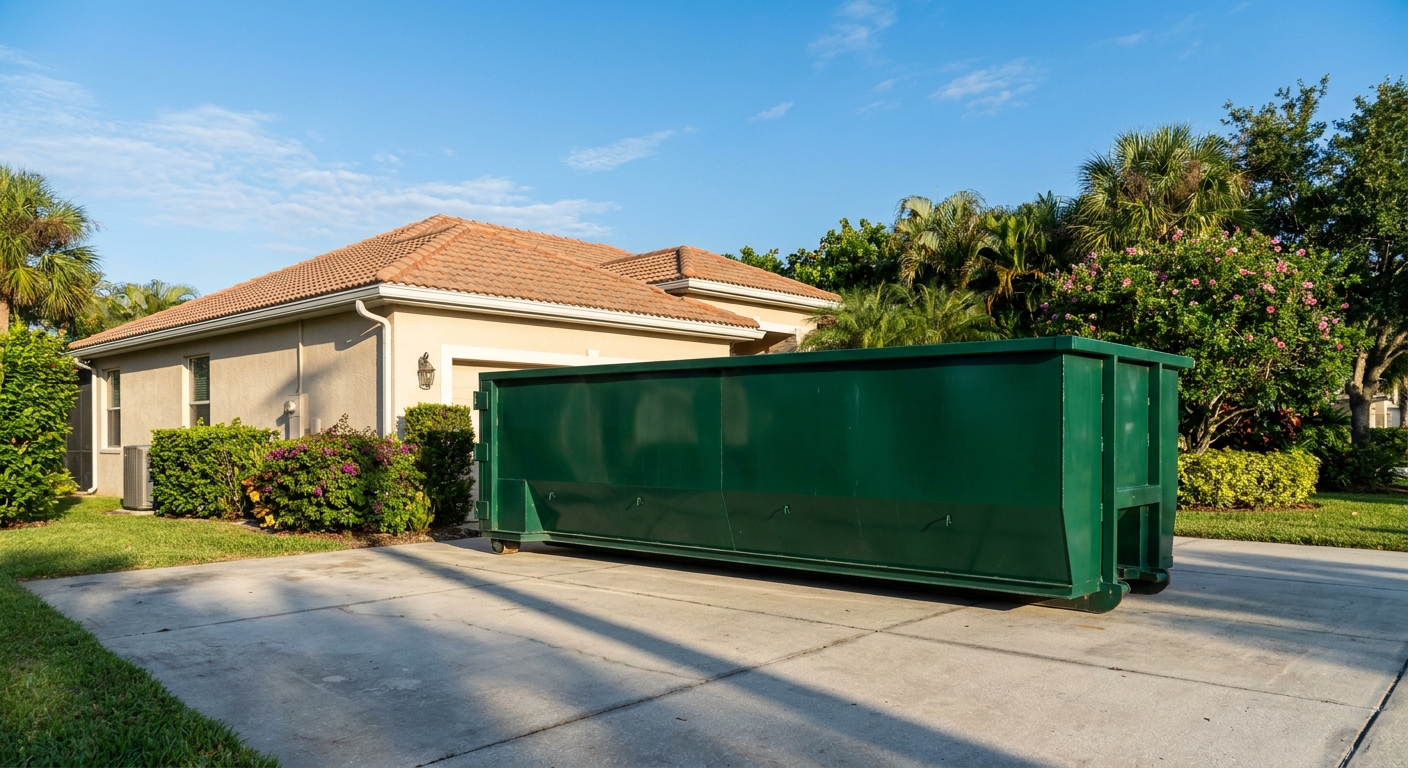
The thing people get wrong about Florida is treating it like one place. It is a long, spread-out state where a dumpster rental that is routine in one city can carry a different price, a different permit rule and a different disposal reality two hundred miles away. North Florida around Jacksonville, Central Florida around Orlando, the Gulf coast around Tampa and the South Florida metro around Miami are effectively four markets stitched together by one interstate, so the right way to think about a Florida roll-off is not statewide, it is city by city. Start from where the box is actually landing, and the rest gets simple.
North Florida is where a lot of the everyday volume lives, and it is where the honest sizing conversation matters most. A Jacksonville dumpster rental for a garage or single-room cleanout usually fits a 10 or 15 yard box, while up in the capital a Tallahassee dumpster rental or a college-town job in Gainesville prices off the same logic: pick the box for the material, not the square footage, because a small box full of heavy debris costs more in overage than the next size up would have cost outright.
The Gulf coast and Central Florida are their own animals. A Tampa dumpster rental or a job across the bay in St. Petersburg often means storm-season debris, wet drywall and downed limbs that fill a box by weight, so the size that holds the weight matters as much as the one that holds the volume. Inland, an Orlando dumpster rental runs on builds and remodels with room on the lot, and down the coast a Cape Coral dumpster rental or a Port St. Lucie job tends to have the driveway space for a bigger box, which is exactly where the value is on a heavy cleanout.
South Florida is the tightest market, denser lots and stricter placement. A Miami dumpster rental or a job up in Fort Lauderdale frequently comes down to whether the box goes on private property or has to sit on a street, and in built-out cities like Hialeah or Pembroke Pines the box that clears the driveway matters as much as the one that holds the debris. Same state as the open Gulf coast lots, opposite problem.
Placement, permits and storms are the part that trips up out-of-state logic. In Florida, like anywhere, a roll-off on your own driveway or lot needs no permit, that is the clean path. The moment the box has to sit on a public street or in the public right of way, most Florida cities require a right-of-way or placement permit from the city, and the rules and fees vary by city, which is exactly why city by city is the right frame. Storm season adds one more layer: after a hurricane, disposal sites fill up and haul times stretch, so if you are cleaning up wet drywall, ruined furniture or yard debris, booking early and sizing up for weight is the honest move. A 20 yard dumpster is the most common box for a Florida residential job because it fits most driveways and covers most cleanouts and remodels, and when you are not sure, the full size lineup lets you match the box to the material before you commit. On price, honest ranges rather than a single made-up number: a 10 or 15 yard in most Florida metros runs roughly $375-500, a 20 yard commonly lands around $425-625, and a 30 or 40 yard for a heavy build or a storm cleanout runs higher, with the real figure tied to your ZIP, your material and your dump fees, not a statewide guess.
One more Florida-specific note worth saying plainly: storm cleanup is real business here, and the ordering flow works the same whether it is a routine remodel or a post-hurricane haul. However you get there, the honest move is to price your exact ZIP so the number you see is real for your address, then pick your day. When you are ready you can order online and get same-day or next-day delivery in most Florida metros, or start from the Florida coverage hub and pick your city so the box, the size and the permit rule all match how your job actually runs. Florida is four markets on one coastline, but yours is just one, and once you name the city the whole thing gets simple.
Florida is effectively four markets: North Florida, the Gulf coast, Central Florida and the South Florida metro. The right box and permit rule are set by your city, not the state, and storm season changes the timing. The bar length is a visual scale of typical box size by region, not a percentage.
“People move here from out of state and assume Florida is one price and one rule. It is not. Jacksonville and Miami and a Gulf-coast storm cleanup are three different jobs before we even talk about the debris. The honest answer is always the same: tell me the city, where the box is landing, and whether it is a storm haul, and I will tell you the size, the permit and the real number. Name the city and the whole thing gets simple.”
From the gulf coast desk
In Florida the first question is always where the box sits. On a private driveway you are clear, no permit, easy. The second it has to go on a public street, most cities want a right-of-way permit and the fee and process are different city to city. I would rather flag that up front than have someone get a citation, so when people order and tell us it is street placement, we catch it for them.
Storm season is the Florida difference. After a hurricane the debris is wet drywall, soaked furniture and yard waste, and that fills a box by weight, not volume, so sizing up saves people the overage. And disposal sites back up, so booking early is the honest move. On the Gulf coast especially, plan the box before the storm, not after.
For commercial accounts across Florida the win is treating each city as its own line item. A crew working Miami and one working Jacksonville are not the same job, and pretending they are is how budgets blow up. We price each city on its real disposal cost and placement rules, so the number holds and the job does not stall waiting on a permit nobody planned for.
TODAY'S NUMBERS · FROM THE ORDER LEDGER
How much does a dumpster rental cost in Florida, and do I need a permit?
Florida dumpster rental prices vary by city because the state is really four markets in one: North Florida around Jacksonville, Tallahassee and Gainesville, the Gulf coast around Tampa, St. Petersburg and Cape Coral, Central Florida around Orlando and Port St. Lucie, and the South Florida metro including Miami, Fort Lauderdale, Hialeah and Pembroke Pines. As honest ranges rather than a single national number, a 10 or 15 yard box in most Florida metros runs roughly $375-500, a 20 yard commonly lands around $425-625, and a 30 or 40 yard for a heavy build or a storm cleanout runs higher, with your real quote tied to your ZIP, your material and local dump fees. The 20 yard is the most common box for a Florida residential job because it fits most driveways and covers most cleanouts and remodels. On permits, the rule is simple and the same logic as anywhere: a roll-off on your own private driveway or lot needs no permit, which is the clean path. The moment the box has to sit on a public street or in the public right of way, most Florida cities require a right-of-way or placement permit from the city, and because the fee and process vary city to city, it pays to handle it up front, which is why Ultimate Dumpsters flags street placement for you at order time. Storm season is the Florida wrinkle: after a hurricane, disposal sites fill and haul times stretch, so for wet drywall, ruined furniture and yard debris, book early and size up for weight. Sizing tips by region: in the denser South Florida metro the box that clears the driveway matters as much as the one that holds the debris, while North Florida and the open Gulf coast lots have more room, so you can size up for material there. The honest move is to price your exact ZIP for a real number, then pick your city on the Florida coverage hub so the box, the size and the permit rule all match your job.
See Florida dumpster rental coverage →FLORIDA CITIES
- Florida coverage hub →
- Jacksonville dumpster rental →
- Miami dumpster rental →
- Tampa dumpster rental →
- Orlando dumpster rental →
- St. Petersburg dumpster rental →
- Fort Lauderdale dumpster rental →
- Tallahassee dumpster rental →
- Cape Coral dumpster rental →
- Port St. Lucie dumpster rental →
- Hialeah dumpster rental →
- Gainesville dumpster rental →
- Pembroke Pines dumpster rental →
Placed by the desks of Ultimate Dumpsters. Every listing is real.
NORTH FL, ROOM ON THE LOT. Garage or single-room cleanout in Jacksonville or up in Tallahassee? A 10 or 15 yard fits the driveway and needs no permit on private property. Price your city.
Jacksonville coverage →GULF COAST, SIZE FOR STORMS. Storm cleanup near Tampa or St. Pete? Wet drywall and downed limbs fill a box by weight, so size up and book early when sites back up. See Tampa coverage.
Tampa coverage →THE FLORIDA WORKHORSE. A 20 yard fits most Florida driveways and covers most cleanouts and remodels. Price a 20 for your ZIP and get a real number for your address.
Price a 20 yard →PICK YOUR FLORIDA CITY. Florida is four markets on one coastline. Start from the coverage hub, pick your city, and the box, size and permit rule all match your job. Same-day or next-day in most metros.
Florida hub →AN ADVERTISEMENT FROM THE PUBLISHER
The Box Arrives Before The Coffee Is Done
(866) 858-3867or skip the call entirely
Order online in about 2 minutesExact local pricing, tonnage and rental days included, e-sign and pay from your phone.
This edition targets Florida city-level dumpster rental queries where dumpsterrentals.us shows real search demand in Search Console, led by the Jacksonville city page with over a thousand monthly impressions, plus the broader Florida location pages, and it weaves the high-impression national terms the site already ranks for on page two such as dumpster rental, twenty yard dumpster rental and dumpster rental near me. It is written to funnel crawl authority and buyer intent into the existing live Florida city pages, not to compete with them. The facts are real and verifiable: Florida roll-off pricing varies by metro and is presented only as honest ranges tied to the customer's ZIP, roughly $375-500 for a 10 or 15 yard, about $425-625 for a 20 yard, and higher for a 30 or 40 yard heavy build or storm cleanup, with no single statewide price implied; placement rules are that private property needs no permit while a box in a Florida public right of way generally requires a city right-of-way permit whose fee and process vary by city, which Ultimate Dumpsters flags at order time; storm season stretches disposal and haul times, so early booking and sizing up for weight are advised; and the 20 yard is identified as the most common residential box because it fits most driveways. External references are the Florida Department of Environmental Protection solid waste management resources and the Florida Department of Business and Professional Regulation construction licensing, both authoritative Florida sources not used in recent editions. Team quotes are verbatim from Ultimate Dumpsters staff. No invented statistics and no proprietary order counts. Article copy drafted with an external model and fact-checked against the live Ultimate Dumpsters ordering flow and Florida coverage pages. Published weekday mornings by Ultimate Dumpsters. Vol. I · No. 37.
Cite this research: Ultimate Dumpsters, “Florida, City by City: How Dumpster Rental Actually Works in the Sunshine State,” The Daily Haul, No. 37, Wednesday, September 2, 2026. https://dumpsterrentals.us/the-daily-haul/2026-09-02