
The Daily Haul
ALL THE DEBRIS THAT'S FIT TO DUMP
Trash Dumpster Rental: What Counts as Household Trash, What Doesn't, How Many Bags Each Size Holds, and Which Box Fits Your Cleanout
A trash dumpster is the open roll-off you rent for one big cleanout, not your weekly garbage pickup. Most of what comes out of a house can go in it: furniture, bags, boxes, rugs, toys, small appliances, even yard waste. A short list cannot: paint, chemicals, propane, batteries, tires and anything with freon. Here is the full list, how many trash bags each size really holds, which box fits which cleanout, and what it costs, with real prices from our live pages.
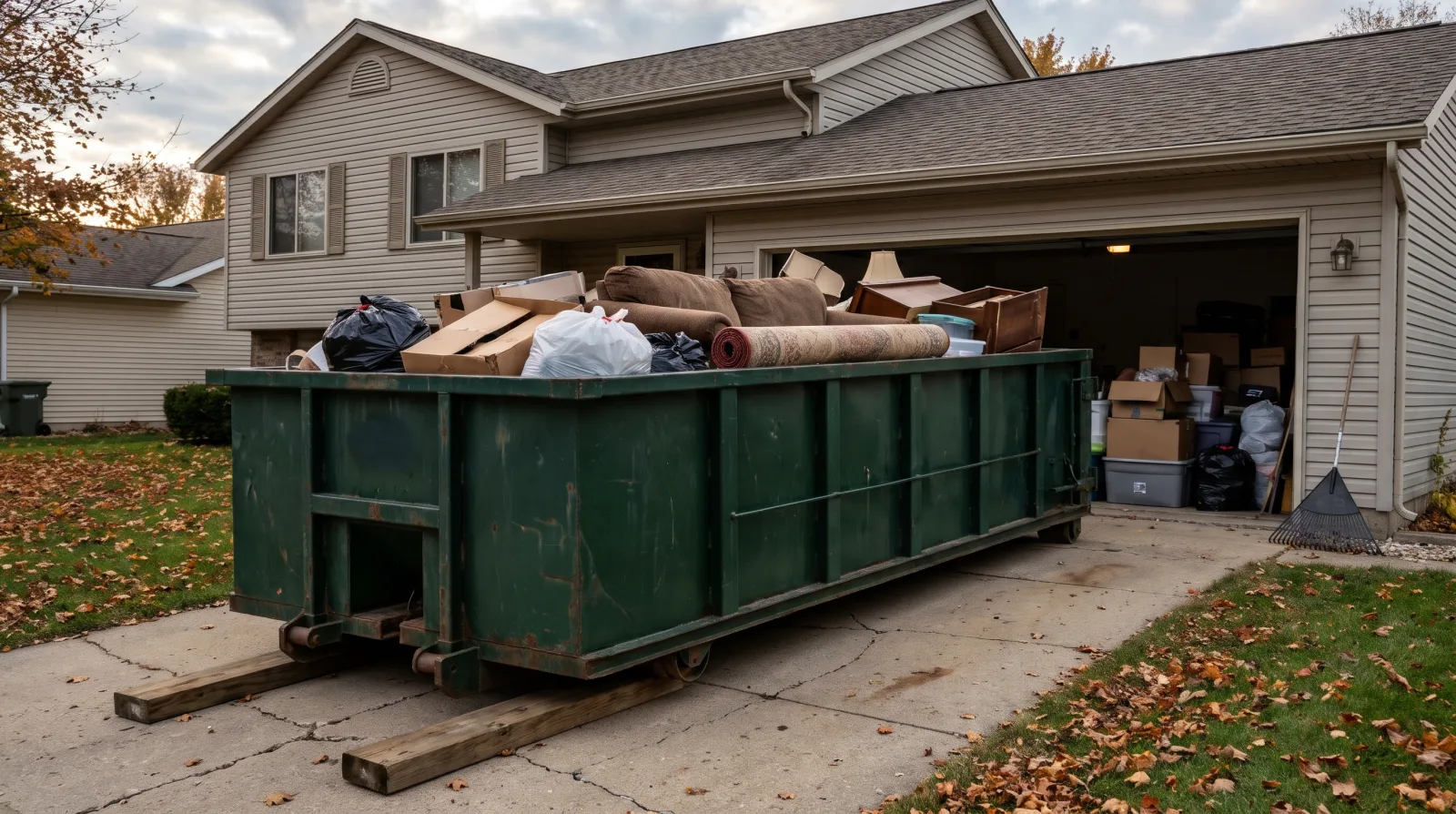
What is a trash dumpster rental?
When people search for a trash dumpster or a trash container rental, they usually mean one of two things. Most mean a roll-off dumpster for one job: a garage, a basement, an estate, a move, a whole-house cleanout. A truck drops the open box in your driveway, you fill it over about a week, and it is hauled away with disposal included. That is what this edition covers. If you need weekly garbage pickup for a home, that is your town or its trash hauler; for a business it is a lidded front-load bin on a schedule, which our commercial waste service quotes to the address.
What counts as household trash?
Almost everything that comes out of a house counts as household trash in a roll-off. Our what can go in a dumpster page lists it: furniture like couches, tables and chairs, clothing and textiles, toys and sporting goods, books and papers, kitchenware, small appliances like toasters and microwaves, lamps and decor, rugs and carpeting, boxes and packaging, shelving, bicycles and swing sets, and mattresses in most areas. Washers and dryers without freon, stoves and dishwashers are fine too. Yard waste, branches, shrubs, leaves and small stumps, can ride in the same box as the household junk.
What can't go in a trash dumpster?
The banned list is short and it is the same almost everywhere. No paint, stains or solvents, no motor oil or antifreeze, no pesticides or household chemicals, and no gasoline or propane tanks. No refrigerators, freezers or air conditioners, because they hold freon. No batteries, no old CRT televisions or monitors, and in most areas no tires, railroad ties or 55 gallon drums. Hazardous items trigger a contamination fee and have to come out before the load can be dumped, so check our prohibited items page and take paint and chemicals to a household hazardous waste drop off instead, as the EPA's household hazardous waste guidance explains. Batteries go to a recycling drop off too, per the EPA's guidance on used household batteries.
How much trash fits in each size?
The easiest way to picture a size is in trash bags. Our live order pages figure about 5.5 to 7 full bags per cubic yard, which makes a 10 yard about 55 to 70 bags or roughly 3 pickup truck loads, a 15 yard about 83 to 105 bags, a 20 yard about 110 to 140 bags or roughly 6 to 7 pickup loads, a 30 yard about 165 to 210 bags and a 40 yard about 220 to 280. Real cleanouts are not all bags, though. A couch or a dresser takes the space of a dozen bags, which is why the bulky pieces decide the size more than the bag count does.
Which size fits my cleanout?
Our team's sizing rule for a house is simple. A garage or a single room is a 10 or a 15. A whole home cleanout, or an estate with a full basement and attic, is a 20, and the 20 is the size most household cleanouts use. A gut renovation, a hoarder house or a big commercial cleanout moves into a 30 or a 40. If you are torn between two sizes, the larger box is almost always cheaper than a second haul. The free size calculator turns your rooms into a size in about a minute.
What does a trash dumpster cost?
Price is set by your ZIP and your material, and it is all inclusive: delivery, pickup, disposal, taxes, 7 rental days and a weight allowance in one number. Across the ZIP codes we price, the typical (median) all inclusive price is $550 for a 10 yard, $695 for a 20 yard, $850 for a 30 yard and $950 for a 40 yard, with weight allowances of about 1 ton on a 10 yard up to 4 tons on a 40. Extra days are billed per day at the rate printed on your quote, and our pricing page shows the live ladder for your area.
Will household trash go over the weight limit?
Household trash is mostly light and bulky, so most cleanouts fill the box by volume long before they hit the weight allowance. Our weight estimator uses about 125 pounds for an average piece of furniture, about 200 pounds for an appliance and 300 to 500 pounds per cubic yard for mixed household junk. What tips a cleanout into an overage is the heavy surprise: tile, plaster, wet carpet, a pile of old concrete in the basement. Mattresses can carry a per item landfill fee in some areas; one facility we work with charges $75 for a mattress and box spring, others charge nothing. Our edition on what a 1 ton dumpster really means walks through the weight math.
How do I load it, and how do I start?
Load it like a moving truck: flat, heavy, sturdy things on the floor first, laid down, then the medium pieces, then work the loose bags into the gaps, in level layers, and keep everything below the top rim. Our loading tips page has the full method. To start, price your exact ZIP and order online in about two minutes, or read how it works first. Not sure if it is a roll-off or a crew with a truck? Our edition on roll-off vs front-load vs bag vs junk removal lays out all four.
Bag and pickup load estimates use the same figures as the live dumpsterrentals.us order pages: about 5.5 to 7 full trash bags and one third of a pickup truck load per cubic yard. Bulky items like furniture take far more room than their weight suggests, October 27, 2026.
| Size | Trash bags | Pickup truck loads | Typical price | Weight included | Best for |
|---|---|---|---|---|---|
| 10 yard | 55 to 70 | About 3 | $550 typical | About 1 ton | A garage, a single room, a small move |
| 15 yard | 83 to 105 | About 5 | Priced by ZIP | About 1.5 tons | Two or three rooms, a basement |
| 20 yard | 110 to 140 | About 6 to 7 | $695 typical | About 2 tons | A whole home or estate cleanout |
| 30 yard | 165 to 210 | About 10 | $850 typical | About 3 tons | A gut renovation, a hoarder house |
| 40 yard | 220 to 280 | About 13 | $950 typical | About 4 tons | A commercial or warehouse cleanout |
Typical prices are the median all inclusive prices across the ZIP codes on the live dumpsterrentals.us pricing page (October 26, 2026), including delivery, pickup, disposal, taxes and 7 days; the 15 yard is priced per ZIP. Bag and load estimates use the live order page figures of about 5.5 to 7 bags and one third of a pickup load per cubic yard.
“The weight estimator is the one I wish every customer used first. People size by how big the pile looks, but a load of concrete or dirt or wet drywall hits the tonnage limit while the box still looks half empty. Run the weight before you pick the size and the overage surprise just goes away.”
Michael V., Head of Operations
Think of it like packing a moving truck. Flat, heavy, sturdy stuff on the floor first, laid down, not standing up, so you get a solid level base. Then medium items, then work all your loose bags and small debris down into the gaps around the big pieces. Build it up in level layers. The mistake is making a pyramid in the middle, that leaves all four corners empty and the box looks full when it is really not.
20 yards are the most common for a reason. They can handle 75 percent or more of projects. Pound for pound it's the best workhorse for most jobs. It's only a little more expensive than the 10 yard, and you get double the size and double the weight allowed. It is never double the price.
For contractors this is bread and butter, but for homeowners it is the one thing worth slowing down on. On a commercial or construction job, we size by tons as much as by yards, because the debris is dense and predictable. A homeowner doing a one-time project just needs to answer one question honestly: is my junk mostly light and bulky, or mostly heavy? Get that right and you order the correct box.
TODAY'S NUMBERS · FROM THE ORDER LEDGER
What can go in a trash dumpster rental, and what size do I need for a household cleanout?
Almost everything from a house can go in a roll-off: furniture, trash bags, boxes, rugs, toys, small appliances, mattresses in most areas and yard waste. Paint, chemicals, propane, batteries, tires and freon appliances cannot. A garage or one room fits a 10 or 15 yard, and a whole home cleanout usually fits a 20 yard, about 110 to 140 bags, typically $695 all inclusive.
Allowed: furniture, clothing, toys, books, kitchenware, small appliances, lamps, rugs and carpet, boxes and packaging, shelving, bicycles, washers and dryers without freon, stoves, dishwashers, mattresses in most areas, and yard waste in the same box. Not allowed: paint, stains, solvents, motor oil, antifreeze, pesticides, household chemicals, gasoline and propane tanks, refrigerators, freezers and AC units, batteries, CRT televisions, and in most areas tires, railroad ties and 55 gallon drums; hazardous items carry a contamination fee. Capacity: about 5.5 to 7 trash bags per cubic yard, so 55 to 70 bags in a 10 yard, 110 to 140 in a 20 and 220 to 280 in a 40. Typical (median) all inclusive prices across the ZIPs we price: $550 for a 10 yard, $695 for a 20, $850 for a 30 and $950 for a 40, with 7 days and 1 to 4 tons included.
Price a trash dumpster for your ZIP →Placed by the desks of Ultimate Dumpsters. Every listing is real.
WHOLE HOUSE CLEANOUT. The 20 yard: about 110 to 140 bags, 7 days and the tons built in.
See the 20 yard →GARAGE OR ONE ROOM. The 10 yard: about 55 to 70 bags, the smallest roll-off on our pages.
See the 10 yard →IS IT ALLOWED?. The full list of what goes in and what stays out, before you load.
Check the list →WHICH SIZE. Tell the calculator your rooms and it picks the box.
Size calculator →NO ONE TO LIFT IT. A crew loads it for you, flat truckload pricing, labor included.
Junk removal →AN ADVERTISEMENT FROM THE PUBLISHER
The Box Arrives Before The Coffee Is Done
(866) 858-3867or skip the call entirely
Order online in about 2 minutesExact local pricing, tonnage and rental days included, e-sign and pay from your phone.
This edition answers what can go in a trash dumpster rental and which size fits a household cleanout using only published Ultimate Dumpsters figures. Allowed and prohibited items are from the live dumpsterrentals.us what can go in a dumpster and prohibited items pages, with the household hazardous waste reference from the U.S. EPA. Trash bag and pickup truck load capacity use the same per cubic yard figures shown on the live dumpsterrentals.us order pages (about 5.5 to 7 bags and one third of a pickup load per cubic yard). Item weights are from the dumpsterrentals.us weight estimator. Typical prices are the median all inclusive prices per size across the ZIP codes in Ultimate Dumpsters' live price list as shown on the pricing page on October 26, 2026, with weight allowances and the 7 included days from the live size pages. The mattress fee example is from the live what can go in a dumpster page. Team voices are from Ultimate Dumpsters staff. No invented statistics and no proprietary order counts. Published weekday mornings by Ultimate Dumpsters. Vol. I · No. 75.
Cite this research: Ultimate Dumpsters, “Trash Dumpster Rental: What Counts as Household Trash, What Doesn't, How Many Bags Each Size Holds, and Which Box Fits Your Cleanout,” The Daily Haul, No. 75, Tuesday, October 27, 2026. https://dumpsterrentals.us/the-daily-haul/2026-10-27
Related guides from the blog
- The 10 Yard Dumpster Is Smaller Than You Think (And When to Size Up)
After 20 years helping first-time renters, here is the thing I repeat every single day: a 10 yard is about the length of a car, it fills up faster than people expect, and a small bump up front usually saves you a second container.
- Is a Roll-Off the Same as a Dumpster? What People Actually Call Us
Roll-off container, trash container, big garbage bin, metal box: our head of operations breaks down every name people use for a dumpster, which ones mean the same thing, and the one word that means something completely different.
- The Complete Guide to Estate Cleanouts
Clearing out a loved one's home is one of the hardest tasks a family can face. This step-by-step guide covers the emotional, logistical, and practical aspects of estate cleanouts from start to finish.