
The Daily Haul
ALL THE DEBRIS THAT'S FIT TO DUMP
Roll-Off, Front-Load, Dumpster Bag or Junk Removal: Which One Your Job Actually Needs, What Each One Holds, and What It Really Costs
Four different things get called a dumpster, and picking the wrong one is the most expensive mistake in this business. A roll-off is the open box a truck slides onto your driveway for one job. A front-load is the lidded bin behind a restaurant that a route truck empties every week. A dumpster bag is a three yard sack for a small cleanup. Junk removal is a crew that loads the truck for you. Here is what each one holds, who does the loading, how pickup works, and what it costs, with real prices from our live pages.
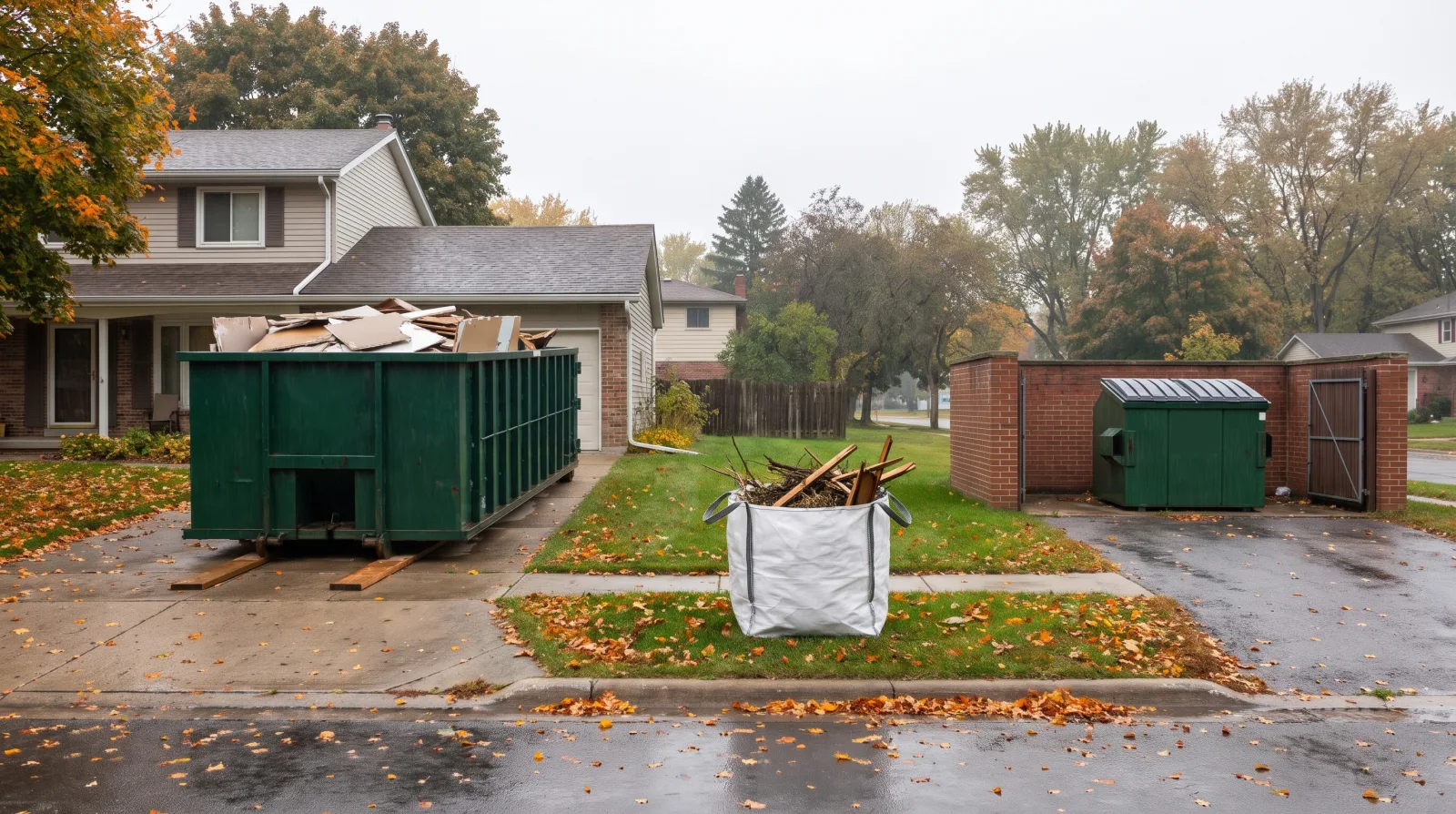
What is a roll-off dumpster?
A roll-off dumpster is the big open top box you see on driveways and job sites. A roll off truck tilts its bed and slides it off in a few minutes, you load it yourself over about a week, and the truck pulls it back up and hauls it away for disposal. It is a one job container, sized in cubic yards: our dumpster rental lineup runs 10, 12, 15, 20, 30 and 40 yards. A 10 yard is about 12 feet long and holds roughly 3 pickup truck loads, a 20 yard about 22 feet long and roughly 6 loads, and a 40 yard roughly 12 loads.
What does a roll-off dumpster cost?
Roll-off pricing on our live pages is all inclusive: delivery, pickup, disposal, taxes, 7 rental days and a weight allowance, set by your ZIP and your material. Across the ZIP codes we price, the typical (median) roll-off is $550 for a 10 yard, $695 for a 20 yard, $850 for a 30 yard and $950 for a 40 yard, with the lower end of each size starting around $495, $625, $750 and $850. Allowances run about 1 ton on a 10 yard up to 4 tons on a 40, and our pricing page shows the live ladder.
What is a front-load dumpster, and who needs one?
A front-load dumpster is a different animal. It is the 2, 4, 6 or 8 yard lidded bin that lives behind a restaurant, a store or an apartment building full time, and a route truck lifts it over the cab with two forks and empties it on a set schedule, daily, weekly or every other week, on one monthly bill. It is for steady everyday trash, not a one time project. Our commercial waste service quotes it to the business address, and the commercial dumpster sizes guide shows which size fits which kind of business.
Is a dumpster bag enough?
A dumpster bag is the smallest option. The best known one is sold at home stores, and its maker publishes the limits: 3 cubic yards, about 8 feet long, 4 feet wide and 2.5 feet high, and up to 3,300 pounds of debris, with collection scheduled and priced separately by location. That is less than a third of a 10 yard roll-off. It works for a small, light cleanup with a spot the collection truck can reach. It does not work for a kitchen, a roof or a basement, which fill it in an afternoon.
When is junk removal the better buy?
Junk removal is the option where somebody else does the lifting. A crew shows up, carries everything out and loads their own truck. Our junk removal uses flat truckload pricing with labor, hauling and disposal included: $349 for a quarter truckload, $495 for a half and $895 for a full truck. It wins for a few bulky items or for anyone who cannot do the loading. It loses on volume, because a 20 yard roll-off holds more than one full truckload, as our dumpster rental vs junk removal page lays out.
Which one should I order?
So the choice comes down to two questions: is this one job or everyday trash, and who is doing the loading? One job you will load yourself over a few days is a roll-off. Everyday trash at a business is a front-load. A tiny, light cleanup can be a bag. A handful of heavy or bulky items, or no one to lift them, is junk removal. The free size calculator picks the roll-off size, and the weight estimator checks the tons before you order.
What do people get wrong when they choose?
The most expensive mistake is the wrong container, not the wrong price. A box that is too small means a second haul, a swap, and you pay for two trips instead of one. A bag that fills in an afternoon becomes a second bag and a second collection fee. A front-load signed for a one time remodel ties you to a monthly schedule you do not need. And heavy material, concrete, dirt, brick or shingles, fills any container by weight long before it looks full, which is why our edition on what a 1 ton dumpster really means is worth reading first.
What is the fastest way to start?
For most home projects, cleanouts, remodels, roofs and moves, the answer is a roll-off, and the 20 yard is the size most of them use. The fastest way to start is to price your exact ZIP and order online, or read how it works first. Running a business that needs weekly pickup instead? Our commercial team quotes front-load service in one call, and our assistant Sam is on chat and the phone 24/7.
Capacities from the dumpsterrentals.us size and commercial pages and the bag maker's published specification, October 26, 2026. A front-load is emptied on a schedule, so its weekly capacity is its size times the pickups. Junk removal is priced by truckload, not by container.
| Option | Holds | Who loads it | How long it stays | What it costs | Best for |
|---|---|---|---|---|---|
| Roll-off dumpster | 10 to 40 cubic yards | You | 7 days included | Typical $550 (10 yd) to $950 (40 yd), all inclusive | One project: cleanout, remodel, roof, move |
| Front-load dumpster | 2 to 8 cubic yards per pickup | You, every day | Full time, emptied on a schedule | Monthly bill, quoted to the address | A business's everyday trash |
| Dumpster bag | 3 cubic yards, up to 3,300 lb | You | Until you schedule collection | Bag plus a collection fee set by location | A small, light cleanup |
| Junk removal | Up to one full truckload per trip | The crew | Gone the same visit | $349 (1/4) to $895 (full truck), labor included | A few bulky items, or no one to lift them |
Roll-off prices are the median all inclusive prices across the ZIP codes on the live dumpsterrentals.us pricing page; junk removal and front-load terms from the live dumpsterrentals.us junk removal and commercial waste pages; dumpster bag capacity from its maker's published product specification. All checked October 26, 2026.
“Contractors usually call them roll-off containers. It's all the same box, we just answer to whatever they call it.”
Michael V., Head of Operations
The biggest way people overpay is not the sticker price, it is ordering the wrong size. Too small and you pay me to come swap it and dump it and bring it back, and now you have paid for two hauls instead of one. That costs way more than if you had just taken the right box up front. So the cheapest thing you can do is spend two minutes telling me the actual job so I size it right. Cheap is not the lowest quote, it is the fewest hauls.
Some people call it a metal box, some people call it a junk box. You get random names all the time. We've heard people call them a big garbage can, meaning a roll-off dumpster, they just didn't know what to call it. That's fine, tell me what you're throwing out and I'll get you the right one.
For a commercial account that fills a box every few weeks, the recurring swap is the whole game. We set a cycle, the full box leaves, an empty one lands, and it becomes a predictable line item instead of a scramble every time the crew runs out of room. Contractors care about that predictability as much as the rate, because it means the job never stalls waiting on a haul.
TODAY'S NUMBERS · FROM THE ORDER LEDGER
What is the difference between a roll-off dumpster, a front-load dumpster, a dumpster bag and junk removal?
A roll-off is an open 10 to 40 yard box dropped on your driveway for one job that you load over about a week; a typical 20 yard runs $695 all inclusive on our live pages. A front-load is a 2 to 8 yard lidded bin a business keeps full time, emptied on a schedule. A dumpster bag holds 3 cubic yards. Junk removal is a crew that loads its own truck, $349 to $895 flat.
Roll-off: one job, you load it, 7 days and a weight allowance included, priced by ZIP and material. Typical (median) all inclusive prices across the ZIPs we price are $550 for a 10 yard, $695 for a 20 yard, $850 for a 30 yard and $950 for a 40 yard, with allowances of about 1 to 4 tons. Front-load: 2, 4, 6 or 8 yards, lidded, lives at the business, emptied daily, weekly or every other week by a route truck on one monthly bill, quoted to the address. Dumpster bag: by its maker's published spec, 3 cubic yards, 8 by 4 by 2.5 feet, up to 3,300 pounds, with collection scheduled and priced by location. Junk removal: the crew loads and hauls, flat $349 for a quarter truckload, $495 for a half and $895 for a full truck, labor and disposal included. Rule of thumb: one job you load yourself is a roll-off; everyday business trash is a front-load; a tiny light cleanup can be a bag; a few bulky items or no one to lift them is junk removal.
Price a roll-off for your ZIP →Placed by the desks of Ultimate Dumpsters. Every listing is real.
ONE JOB, YOU LOAD IT. Roll-off, 10 to 40 yards, 7 days and the tons built into one price.
Price your ZIP →WEEKLY TRASH. Restaurant, store or building? A front-load on a set schedule, one monthly bill.
Commercial service →WE DO THE LIFTING. A few bulky items or no one to load? Flat truckload pricing, labor included.
Junk removal →WHICH SIZE. Tell the calculator the job and it picks the roll-off size.
Size calculator →THE 20 YARD. The size most cleanouts, remodels and roofs use.
See the 20 yard →AN ADVERTISEMENT FROM THE PUBLISHER
The Box Arrives Before The Coffee Is Done
(866) 858-3867or skip the call entirely
Order online in about 2 minutesExact local pricing, tonnage and rental days included, e-sign and pay from your phone.
This edition compares the four common ways to dispose of debris using only published figures. Roll-off prices are the median and low-end all inclusive prices per size across the ZIP codes in Ultimate Dumpsters' live price list, as shown on the dumpsterrentals.us pricing page on October 26, 2026, with weight allowances and the 7 included days from the live size pages. Capacity in pickup truck loads is from the dumpsterrentals.us size pages. Junk removal truckload prices are from the live dumpsterrentals.us junk removal and dumpster rental vs junk removal pages. Front-load sizes, schedules and billing are from the live dumpsterrentals.us commercial waste and commercial dumpster sizes pages; front-load service is quoted per address, so no price is given. Dumpster bag capacity, dimensions and weight limit are from the bag maker's published product specification (thebagster.com, checked October 26, 2026); its collection fee varies by location and is not stated. Team voices are from Ultimate Dumpsters staff. No invented statistics and no proprietary order counts. Published weekday mornings by Ultimate Dumpsters. Vol. I · No. 74.
Cite this research: Ultimate Dumpsters, “Roll-Off, Front-Load, Dumpster Bag or Junk Removal: Which One Your Job Actually Needs, What Each One Holds, and What It Really Costs,” The Daily Haul, No. 74, Monday, October 26, 2026. https://dumpsterrentals.us/the-daily-haul/2026-10-26
Related guides from the blog
- Front-Load vs. Roll-Off for Your Business: How to Actually Decide
Permanent front-load service or temporary roll-off containers? Joe Woods breaks down the decision the way he does for national accounts: by waste volume, cadence, and what your operation actually produces.
- Roll-Off vs Front-Load Dumpsters: Which Is Right for You?
Roll-off and front-load dumpsters serve very different purposes. This guide explains the differences in design, capacity, pricing, and use case so you can choose the right container for your project or business.
- Commercial Dumpster Service: Everything Your Business Needs to Know
From selecting the right container to managing costs and staying compliant with regulations, this guide covers every aspect of commercial waste management for businesses of all sizes.